Tuesday, May 21, 2013

Coconut Shortbread with Cardamom


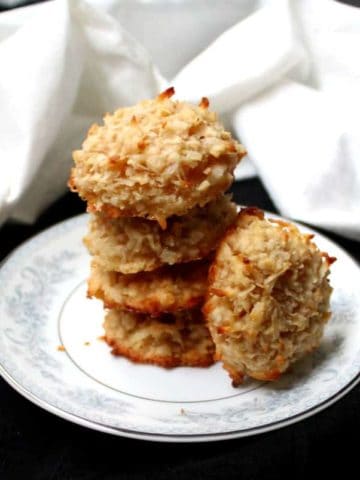
Indian sweets often combine the classic medley of coconut, cardamom and sugar. In my Coconut Shortbread, I use these Indian ingredients to put a delicious spin on a Scottish favorite.

Desi loves shortbread and so do I. What's not to love about a cookie that's utterly simple and yet stunningly exquisite?  I make my vegan shortbread for him often enough, but this time I wanted to try something different and something possibly healthier. Therefore, Coconut Shortbread.

For my Coconut Shortbread I chose not use coconut flakes-- I don't like the idea of anything, even delicious flakes, interrupting the perfect texture of shortbread. Instead, I substitute the butter with coconut oil. And then add a smidgen of coconut milk to intensify the flavor.


Coconut oil is a great substitute for butter in shortbread and other recipes that require flaky crusts, like pies, and even in cake frosting. That's because it remains solid at room temperature in all but the most tropical climates, like shortening would. Be sure to use an organic variety to make sure you get the purest flavor and texture.

One thing to keep in mind when baking with coconut oil is that it has a strong, coconutty flavor, so don't use it in a recipe where you want a neutral flavor. It works perfectly in this shortbread, though, because we want it to be as coconutty as possible. The reason I said that this shortbread is possibly healthier than regular shortbread is because some research shows coconut fat is actually heart-healthy (although any fat is still fat, so moderation is key).

Cardamom makes this shortbread extra-special and reminds me a little of Naralachi Barfi, an Indian coconut fudge that is a sweet childhood memory. My mom would often make these soft and diamond-shaped barfis for my brother and me when we were kids and they would be pink or blue, exactly as a child would love them. They filled the house with the heady fragrance of sugar, coconut and cardamom, much like this shortbread does.

Enjoy, all!

Coconut Shortbread

Ingredients:

1 1/2 cups all-purpose flour

1/2 cup coconut oil

1/4 cup coconut milk, cold

1 1/4 cups powdered sugar

1 tbsp pure vanilla extract

1/4 tsp salt

1 tsp powdered green cardamom

1 tbsp sugar for dusting shortbread (optional)

Mix together the flour, cardamom powder, and salt.

Cream together the coconut oil and the powdered sugar with a hand mixer or in a stand mixer until it's soft and fluffy, about two minutes.

Add the coconut milk and vanilla and mix well.

Add the flour in three batches, mixing well with a spatula after each addition.

Cover and refrigerate the dough for 15-30 minutes.

Grease an 8 by 8 inch glass baking pan.

Place the shortbread dough in the pan. Press with your fingers into an even layer all the way to the corners of the pan.

Bake the shortbread in a preheated 300-degree oven for 50 minutes or until it is slightly darker at the edges.

Remove to a rack, cool for 10 minutes, and then, using a sharp knife, cut into diamond shapes without going all the way through the shortbread.

Cool thoroughly and then separate into diamond shapes.
Print Friendly and PDF

Thursday, May 16, 2013

Quinoa Biryani with Kala Chana


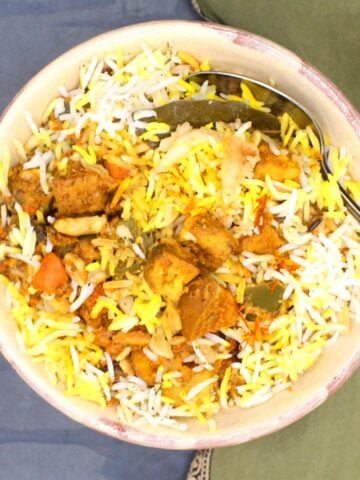
A biryani may be the ultimate indulgence, food-wise, but truth is that it can also be transformed into a super-healthy-- and decadently delicious-- weeknight dish. All you need to work that magic is your imagination.

My Quinoa Biryani with Kala Chana has all the flavor of a traditional biryani because it has the same spices and flavor building blocks-- with important modifications to the two main ingredients, the rice and the meat. The rice is replaced by nutty quinoa, a wonder food and one of the best sources of vegan protein, and the meat is replaced by kala chana, a smaller, darker version of a chickpea or garbanzo bean that you can find at any Indian store. Kala chana has more flavor and texture and it holds more firmly after cooking, compared to a chickpea. All of which makes it a wonderful meat substitute in this dish. And being a legume, it's also packed with protein, of course.

You can substitute chickpeas in this recipe, but the flavor won't be as hearty. Be sure to cook your chickpea to a slightly al dente texture instead of letting it get too mushy. And don't forget to rinse your quinoa thoroughly before you cook it to get rid of the saponin, a bitter coating that covers and protects each grain until it's ready for you to eat.

Print Friendly and PDF

Tuesday, April 23, 2013

In My Kitchen, April 2013


What's in my kitchen this month?

This Spaghetti Gratin with Artichoke Cashew Cheese. But first, what else is in my kitchen?

I turned an interested eye to the most used room in my home after reading Nupur's post which in turn was inspired by a meme hosted each month by Celia of the blog Fig Jam and Lime Cordial. It is such a great idea, I couldn't wait to get started!

My kitchen, like everyone else's I suppose, is the heart of my home. It's the place I enjoy being in most because I love to cook and to eat. It's the place where we spend many evenings chatting about the important  things and the trivial.  It's where guests seem to naturally congregate, no matter how comfortable the other rooms are.

Print Friendly and PDF

Monday, April 15, 2013

Gluten-Free Multigrain Pancakes

It's not easy to be vegan and discuss weight gain.

Vegans, we are told unequivocally by all the experts in the field of plant-based nutrition, don't gain weight. And if they do, it's because they are doing something wrong. They are eating too much junk. Or they are eating too much. Period. It makes those among us who watch what we eat but also have to watch the scales feel very guilty. And very helpless.

I worked for a plant-based nutrition advocacy group where the message about vegan diet equals weight loss was drilled deep into our heads. But at work, even as I was expected to push out messages to the media about vegans not getting fat, I felt more than a little hypocritical and very angry. Because my mirror was telling me quite something else. I was a vegan and I was putting on weight.

Print Friendly and PDF

Thursday, April 11, 2013

Mushroom Achari


Baingan Achari is a mouthwatering side-dish that cashes in on the great Indian obsession with pickles. Indian pickles, called achar in north India, are quite different from the pickles we eat here in the United States. They are made with all sorts of vegetables-- mango and lemon being the more popular choices-- and they are fiery red with bold tones of tart and hot that tease your tastebuds and whet your appetite.

The reason why pickles taste so special are a couple of very special spices that go into them: nigella seeds, or kalonji, and fennel seeds, or saunf. Baingan Achari takes the alchemy of those spices and puts them to work in a subzi, or a side dish, that is much quicker-- and easier -- to make than a jar of pickles, and has about the same effect on the appetite.

In my eggplant-loving home Baingan Achari is always a popular choice for dinner. But the last time I had a craving for this dish I didn't have any eggplant on hand. I did have some mushrooms, though, so I thought, why not?

Print Friendly and PDF