

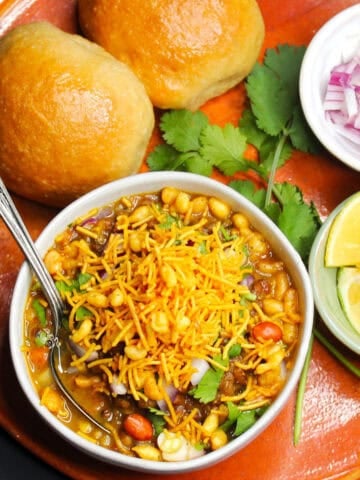
Vadakari is a tasty, spicy curry made with lentil dumplings in a creamy sauce. Serve hot with pooris or parottas.
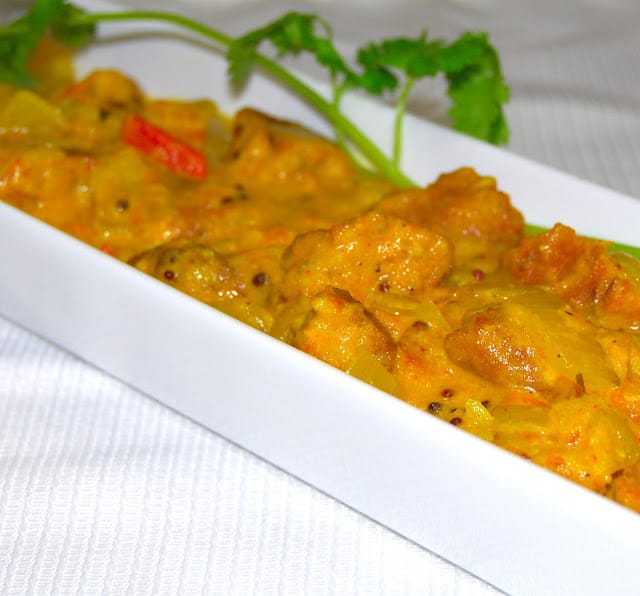
Desi's the kind of guy who usually just eats whatever I cook, but sometimes -- to my delight-- he will come up with a special request. Usually it's a taste from his childhood in Madras. This past weekend it was a request for Vadakari (also sometimes called Vada Kari or Vadai Curry), a spicy dish he and his brothers would sometimes order at a hole-in-the-wall restaurant in Chromepet, a suburb of Madras where he grew up.
Vadakari is exactly what it sounds like (well, at least to a Tamilian). It is a curry, or a spicy gravy of tomatoes and onions with tiny little lentil dumplings, or vadai. The vadai are deep-fried, then broken into little pieces and added to the gravy, which gives them a really great chewy texture.
Here's the recipe. Enjoy, all!
Vadakari Recipe
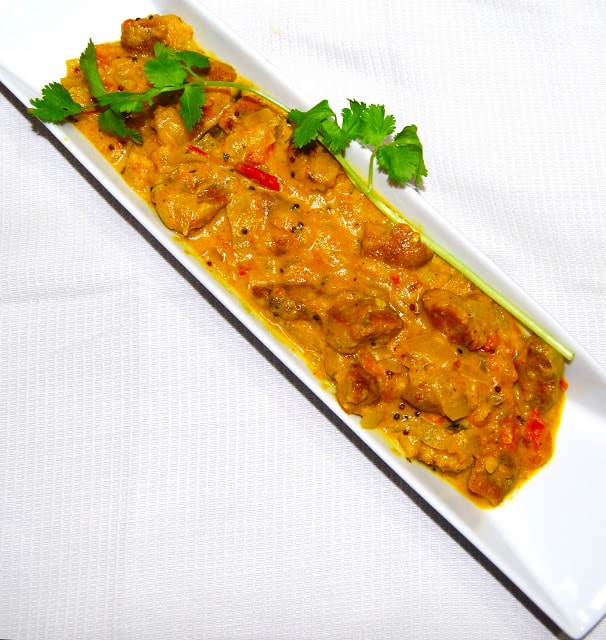
Recipe card
Vadakari
Ingredients
For the vadai:
- 1 cup chana dal (bengal gram dal)
- ¼ cup brown rice flour
- 2 red chili peppers
- 1 teaspoon fennel seeds
- 1 teaspoon cumin seeds
- ¼ teaspoon turmeric
- Salt to taste
- 4 tablespoon avocado oil or any neutral oil
For the curry:
- 1 teaspoon black mustard seeds
- 1 onion (finely chopped)
- 3 cloves garlic (minced or crushed with a garlic press)
- 10-12 curry leaves
- 1 tablespoon ginger paste
- 1 large tomato (finely chopped)
- ½ teaspoon cayenne (or any red chili pepper powder)
- ¼ teaspoon turmeric
- 1 teaspoon garam masala
- A generous pinch asafetida or hing (hing)
- 1 teaspoon avocado oil or any neutral oil
- 1 cup coconut milk
- Salt to taste
- 2 tablespoon cilantro (for garnish)
Instructions
Make the vadai:
- Soak the chana dal for 3 hours or if you don't have the time do what I did and cheat- put the chana dal in a microwave-safe bowl, add enough water to top the dal by at least an inch, and zap for three minutes. Then drain.
- Grind the chana dal with the rest of the ingredients. If the processor or blender blades refuse to turn because the mixture is too dry, add just a tiny bit of water, a tablespoon at a time. You want a coarse paste that clumps together, but it should not be too watery or you won't be able to form your vadas.
- Form 1-inch vadas by pulling off a piece of the dough, rolling it into a ball, and then flattening it between your palms. I got about 16 vadas.
- Heat the oil in a wok or saucepan. Deep-fry the vadas until they are golden-brown. Don't let them brown too quickly or they'll stay raw inside. Drain onto a paper towel. Once the vadais are cool enough to handle, break them up into small pieces.
Make the curry/gravy:
- Heat the oil in a saucepan. Add the mustard seeds and asafoetida. When the seeds sputter, add the onions and curry leaves.
- Saute until the onions start to turn transparent. Add the ginger and garlic and stir well, about a minute. Add the tomatoes.
- Add the turmeric, chilli powder, and garam masala powder. Mix them in and saute the mixture until the tomatoes are all crushed into a paste and most of the liquid has evaporated.
- Add a cup of water, bring it to a boil, then add the pieces of vadai. Once the vadai absorb most of the water, add coconut milk and salt to taste.
- Stir well, bring the curry to a boil, and let it simmer another five minutes. Turn off the heat and add chopped coriander leaves.
- Serve hot.
Nutrition Information
To print recipe card without images, uncheck "instruction images" after clicking the "print recipe" button.


hitesh says
vaishali,,,
nice to know about the same.keep it up....
regards
hitesh
Sarah says
This turned out really well! Hearty and amazing. I really loved the texture. I had never heard of Vadai or a Vadai curry before (the horror!), but I am so glad I do now. I never would have thought to make them into a curry - very unique, and another hit among the many I have had from your site.
Vaishali says
Hi Hannah, If you ensure that the temperature of the oil stays between 350 and 375 degrees all of the time, the food absorbs almost no oil. And be sure to drain off the vadais on paper napkins to ensure that any oil stuck on gets wiped away.
I use canola oil all the time, but any vegetable oil would be fine except those with low smoking points, like olive oil. And yes, you need to monitor the browning of the vadas carefully. Stay with them and turn them over as they brown to ensure nothing's getting too dark. They should be golden-brown when ready.
Hannah says
Hi Vaishali! I've never deep fried anything but I reckon your recipes are generally healthy and after all it's Xmas! But could you elaborate a little on the method please? What oil do you use (olive or canola?) and how much? And how do you control how fast they brown? Thanks so much and I look forward to trying this next week!
Vaishali says
Manasi, I confess I have a thing for dumplings in gravy too. 🙂
Rajee, I can imagine this would be divine with a flaky parotta.
Divya, Richa, Priya, Thanks!:)
Madhu, ooh, vadakari with pongal sounds lovely. Reminds me also how long it is since I last had pongal-- gotta make some soon. 🙂
Poornima, thanks! 🙂
Poornima Nair says
Manoj will love this curry too, we've had it a friends place and loved it. This looks soo good.
Anonymous says
Hi Vaishali,
My husband loves vadakari a lot!!! The pictures really speak a lot and wants me to splurge a little and get it done asap :p. We usually serve it with Idlis or pongal at home, but it will definitely be good with anything or just as is :). Good job!!
-Madhu
Priya says
Its been ages i had this vadakari,simply inviting.
Richa says
i've never heard of this one.. so it definitely goes into must try list! i love the long tray and the puffy pooris! ahh,, om just left after feeding us a bunch of pooris and parathas..:)
divya says
Wow looks so delicious...yummy and beautiful clicks
Rajee Mani says
Lovely recipe. This is one thing I guess all of us who grew up in Chennai love to have esp for the nostalgic memories associated with it. The best combination in my opinion is vadakari with the South Indian style Parota. Its divine 🙂
Manasi says
This, I must make! I like pooris too and anything that is a dumpling in a gravy is heaven:)